02 December 2025
By Adrian Thomas,
Honorary Historian, The British Institute of Radiology.
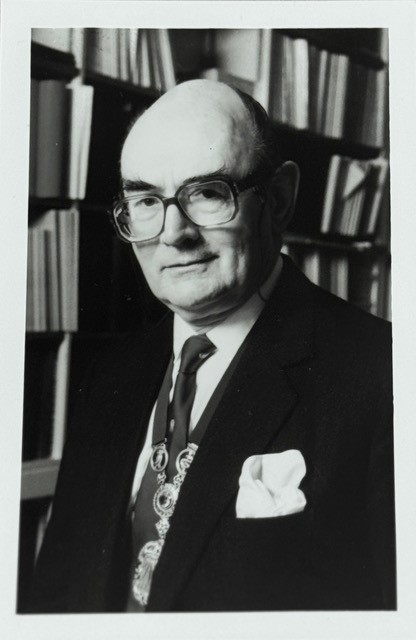
Charles Albert Frederick Joslin, known to many as Joss, died on 30 October 2025 at the age of 97. Since he retired some 32 years ago, many may not remember him or the major contributions that he made to radiation oncology.
Charles was born on 2 April 1928 in the ancient market town of Braintree in Essex. As a young man Charles developed an interest in electronics and in April 1949 joined the second year of a two-year course in telecommunications engineering. J.B. McMillan, the Director of College Studies at EMI Institutes, Ltd., described him as ‘a highly intelligent young man and an excellent student’. He completed the course in March 1950, obtaining the Full Technological Certificate in Telecommunications Engineering at the City and Guilds of London Institute.
Charles recalled that from 1958 he did the usual pre and post registration jobs. It was because of his electronic engineering background that he became interested in the technical aspects of radiotherapy. His training was at Charing Cross Hospital and the Royal Postgraduate Medical School at Hammersmith Hospital. Charles met and married Ann Gibson, who was a medical art student at Charing Cross Hospital Medical School and was studying in the dissecting room. They had two sons and a daughter, all married with families, and grandchildren.
His double life in medicine and electronics continued even after qualifying as a doctor. As a houseman he served on the Council of the British Institute of Radio Engineers and as was a founder member of the Biological Engineering Society. His work in electronics continued to about 1970.
In 1961 Charles started training in radiotherapy at Charing Cross Hospital where the UK’s first Cathetron unit was being evaluated. Following a visit to the United States he met Ulricht Henschke, and became interested in brachytherapy afterloading techniques. At Charing Cross Hospital Dr Peter Kunkler followed by Dr Daniel O'Connell were exploring the clinical possibilities of using afterloading techniques for treating gynaecological cancers.
The Cathetron unit employed remotely-controlled positioning of high activity cobalt-60 radioactive sources within the patient. This replaced the earlier forms of brachytherapy which involved the manual positioning of low-activity radium-226 or caesium-137. The new technique removed the radiation protection problems for staff and allowed the treatment to be delivered in minutes rather than days. During this early period Charles worked closely with the radiotherapist Daniel O’Connor, and physicists W E ‘Bill’ Liversage and Norman Ramsey.
At that time there was virtually no clinical experience in the use of high activity sources for treating gynaecological cancer. Having taken part in some experimental laboratory work and various clinical applications, Charles moved to Velindre Hospital, Cardiff, as an NHS Consultant Radiotherapist, joining his previous chief Peter Kunkler. He was a Clinical Teacher at the Welsh National School of Medicine.
At Velindre Hospital he continued his work with the Cathetron taking charge of the clinical development of the machine and rapidly moved from treating patients on a pre-operative basis to treating on a radical basis. Other applications which originally began at Charing Cross Hospital were also developed, including the afterloading of treatment moulds for treating skin cancers. These were exciting times in radiotherapy with new developments such as high energy linear accelerators, treatment simulators, hyperbaric oxygen and the ‘Ellis’ mathematical model for radiotherapy. His major interest remained with the clinical development of high activity afterloading which resulted in him becoming known internationally.
In 1974 he was appointed Professor of Clinical Oncology in the Department of Radiotherapy at Leeds University, based at Cookridge Hospital. At Cookridge he continued to develop his interest in high dose-rate brachytherapy, and became a high-profile international figure in the field. High dose-rate brachytherapy is widely used and Charles was one of a small number of pioneers who led the way to identifying its safe and successful application. His contributions were acknowledged in 1988 by the awarding of The Ulrich Henschke Award for ‘High Activity Source Afterloading in Gynecological Cancer and Its Future Prospects’. The award is the highest honour that the American Brachytherapy Society can give.
Charles took a great interest in his staff, giving much support and gentle direction. His relatively small department saw the award of higher degrees at the rate of almost one a year, and a very creditable publications record in the fields of gynaecology, urology and breast
malignancies, and in scientific laboratory work. The department ran a five-day course for medical undergraduates. He also undertook postgraduate training and established a visiting radiotherapy fellowship.
Although radiotherapy was his primary subject, he was also committed to various research and cancer programs ranging from radiobiological research, regional and national clinical cancer trials, the national breast cancer screening program, terminal care facilities (he was adviser to the Sue Ryder Foundation), cancer statistics and quality assurance and control programs in radiotherapy. He was an Advisor in Radiotherapy to the Chief Medical Officer in the Department of Health (1980-86) and helped with DoH enquiries into two radiation accidents.
Charles believed that if we could detect cancers at one or two stage levels earlier, then this would have a greater impact in cure rates than would result from any major treatment advance, hence the need for screening programmes. To that end he was appointed Vice-Chairman of the Forrest Committee which developed the UK breast screening programme. At the Symposium Mammographicum '87 meeting he presented a paper and noted that the success of the programme would depend upon the quality assurance measures and on the goodwill of all concerned to work within a highly disciplined system. However, without adequate earmarked funding to back it, there would be a real danger of the service losing credibility.
Over the years Charles was a high-profile figure at innumerable workshops and conferences, often as a key speaker or session chair. He gave several eponymous lectures, and published widely and contributed chapters to a number of specialist books. He was joint-editor with A. Flynn and E. J. Hall of the highly-commended ‘Principles and Practice of Brachytherapy: Using Afterloading Systems’ published in 2001.
Charles could be direct and would always speak his mind. However, he also had a very generous side and at meetings frequently paid wholesome acknowledgement to colleagues and members of his team.
Charles was President of the British Institute of Radiology in 1990-91, and as President was well aware of the important work of the Institute and of the role it could play in the future development of radiology. In 2002 he was awarded the Honorary Fellowship of the Institute.
At the Royal College of Radiologists, he served on Council, Faculty, Education and Visits committees.
Charles retired in 1993 and the University of Leeds appointed him Emeritus Professor. After retirement he wrote that he had enjoyed his professional life with few regrets and now hoped to resist serving on any more committees or writing papers. He had a reputation for ‘collecting committees’. He then noted that his ‘last professional lecture was four years ago and it's time to open up another bottle. Cheers!!’
Charles lived life to the full. He was an enthusiast for Jaguar cars and at one time owned a top-of-the-range model with its enormous V12 engine. Charles was something of connoisseur with regard to single malt whisky and wine. He would often invite colleagues to join him in rounding-off a conference dinner with a tipple. He and his wife Ann were life members of the Harrogate Medical Wine Society and actively participated in its meetings. He and Ann were Friends of the Mercer Art Gallery in Harrogate, of which Ann served as Deputy Chairman.
He had an impish sense of humour. Roger Dale recalled attending a conference in the USA when attendees were issued with ridiculous large and flowery name badges coded according to status. Charles opened his session with the usual pleasantries and then added ‘As I look around, I rather feel like a judge at a cattle show.’ The joke was well received. Charles also wrote some short autobiography notes, and noted that ‘they read like an obituary!’ He then commented that: ‘It will be up to the reader to decide whether I am alive or dead, if only from the neck up!’ Sadly, this is now an obituary, and the world is a lesser place for his passing.
Thank you to Chantelle Joslin and Roger Dale for their help.

